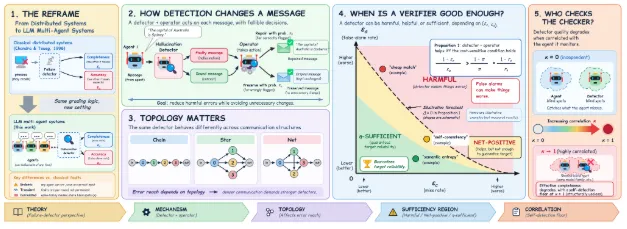
This project studies when error detection and intervention can reliably improve multi-agent LLM systems, where mistakes from one agent may propagate through later interactions and affect the team’s final answer. We characterize detector quality along two dimensions: missed errors and false alarms. And ask how accurate a detector must be before intervention becomes beneficial. Extending the Chandra–Toueg theory of unreliable failure detectors, we derive conditions linking detector quality to communication topology, intervention strength, detector placement, and error correlation. We then test these conditions across chain, star, and network-structured agent teams and use the resulting framework to assess whether existing hallucination detectors are reliable enough for safe intervention.
Team: Sami Rashid, Md Akil Raihan Iftee, AKM Mahbubur Rahman, Amin Ahsan Ali, Sajib Mistry