Beyond Euclid: An Illustrated Guide to Modern Machine Learning with Geometric, Topological, and Algebraic Structure, by Sanborn et al.

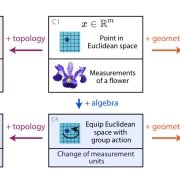
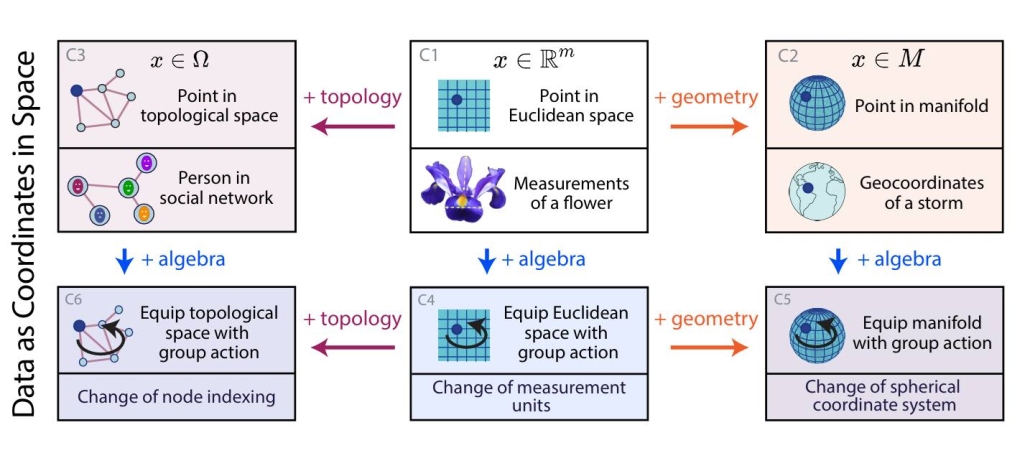
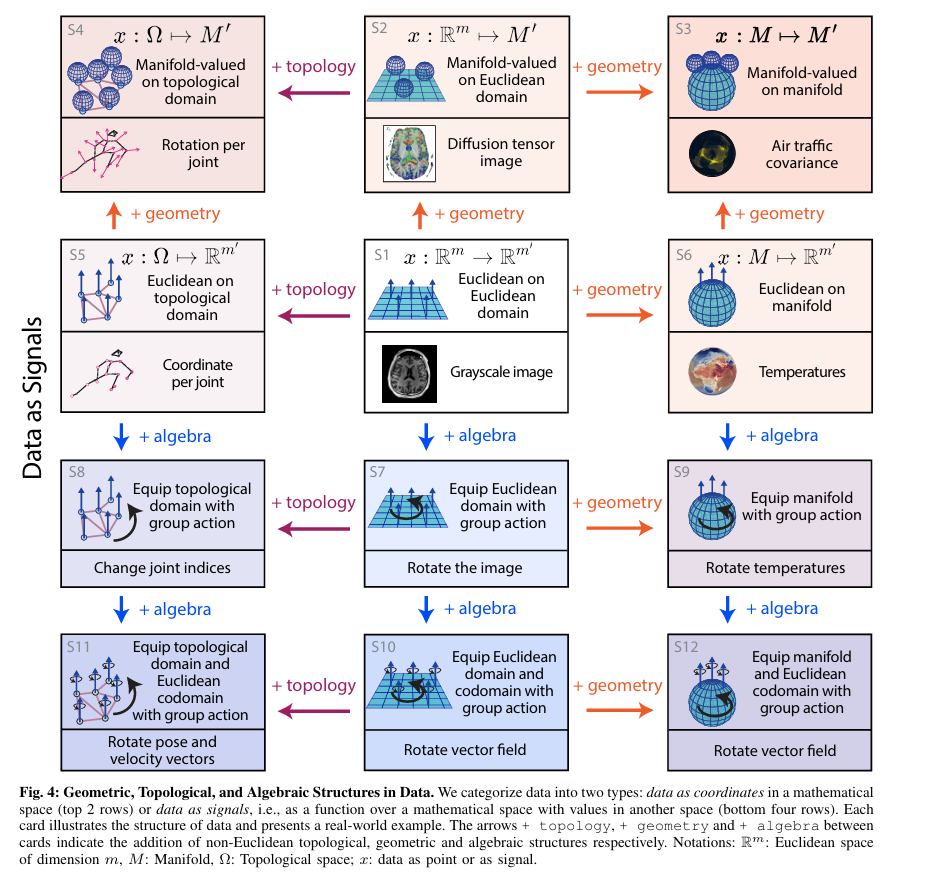
The two images below are from the article titled – Beyond Euclid: An Illustrated Guide to Modern Machine Learning with Geometric, Topological, and Algebraic Structure, by Sanborn et al. (https://arxiv.org/abs/2407.09468v1)

The paper talk about how “the mathematics of topology, geometry and algebra provide a conceptual framework to categorize the nature of data found in machine learning.” The two figures, present a “graphical taxonomy, to categorize the structures of data.” The article the authors discuss two types of data that we generally encounter: “either data as coordinates in space—for example the coordinate of the position of an object in a 2D space; or data as signals over a space—for example, an image is a 3D (RGB) signal defined over a 2D space. In each case, the space can either be a Euclidean space or it can be equipped with topological, geometric and algebraic structures.”

The paper goes on to then “review a large and disparate body of literature of non-Euclidean generalizations of algorithms classically defined for data residing in Euclidean spaces.” The algorithms presented assume that certain topological, algebraic, or geometric structures of the data / problem are known. However, it does not go into discussion on methods where such structures are not known. For example, methods that fall into the category of topological data analysis, metric learning, or group learning are not covered.
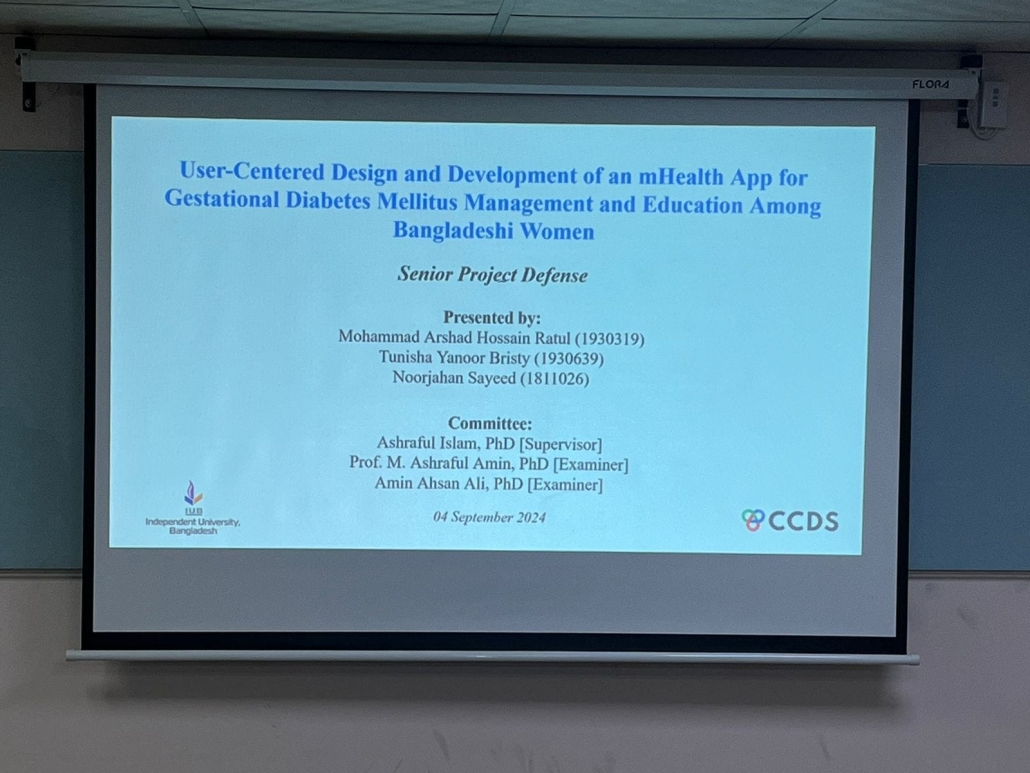
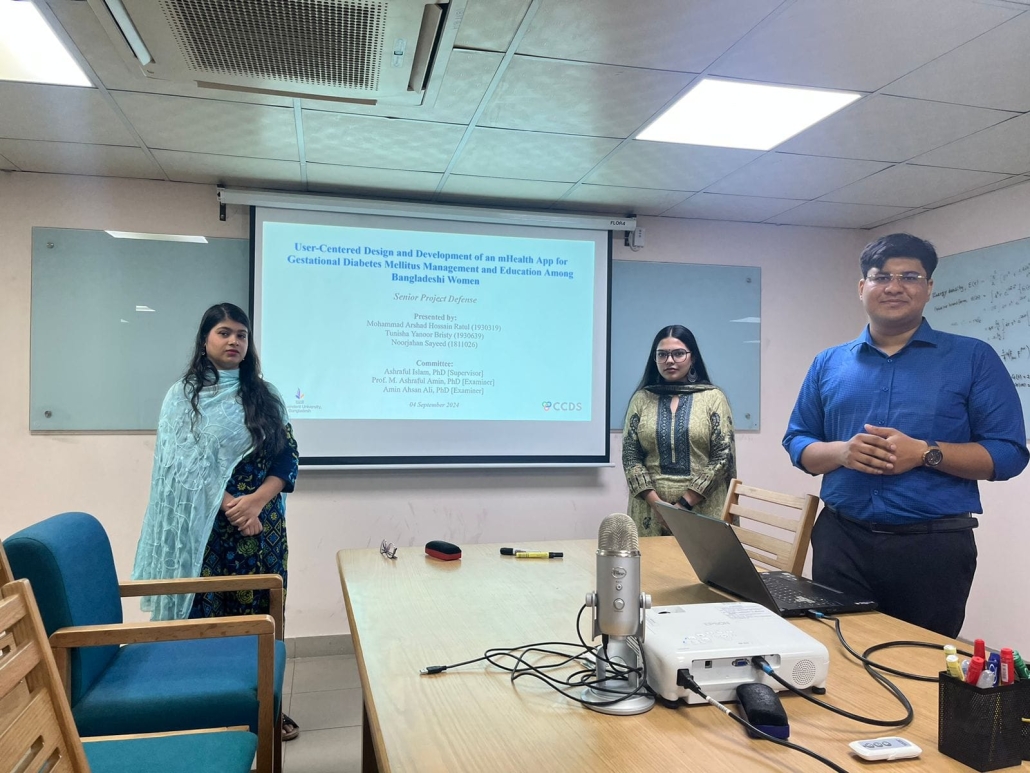
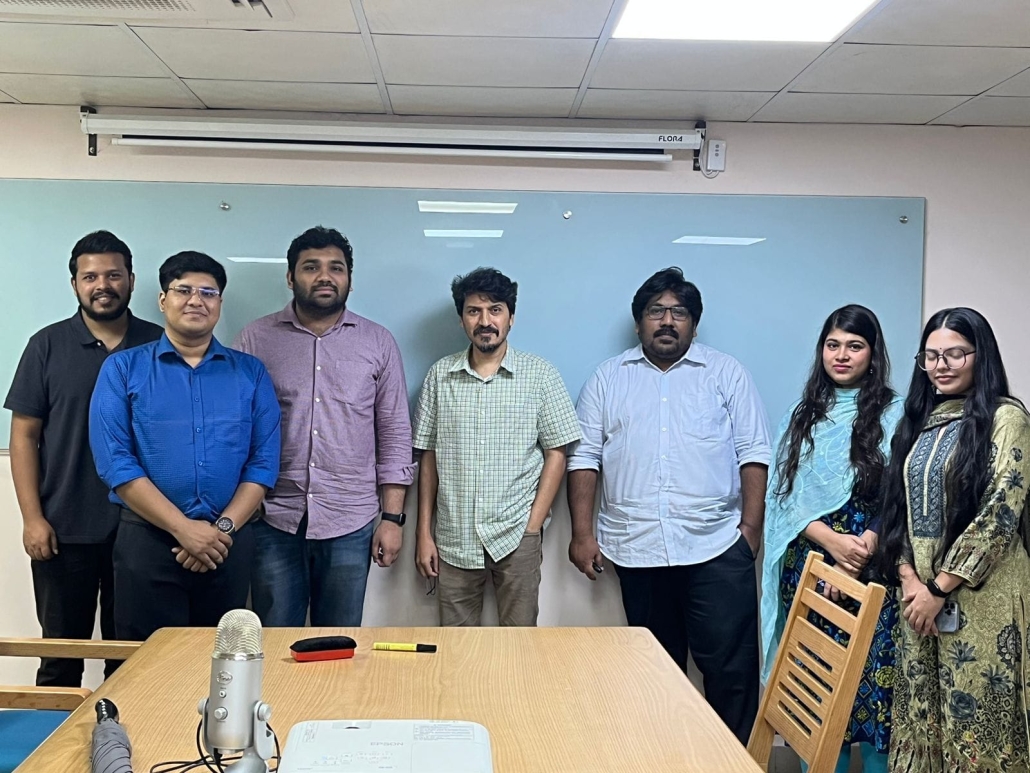
First undergrad group complete their senior project from the HCI wing.

Congratulations to them 🎉

It should be mentioned that, during this project they published 2 conference papers and another article is in preparation.

CCDS student James selected for the CERN Summer Student Program 2024

The Centre for Computational and Data Sciences (CCDS), Independent University, Bangladesh (IUB), is proud to announce that James Peter Gomes, a dedicated undergraduate research student at CCDS and a Physics (Honors) major student in the Department of Physical Sciences, was selected earlier this year to participate in the prestigious CERN Summer Student Program 2024. He was the only Bangladeshi student amongst the 300 selected out of around 10,500 applicants worldwide. The fully funded 8 weeklong program was held at CERN’s Meyrin site in Geneva, Switzerland from 24th June to 16th August 2024.

🟦For those who are not aware, CERN, the European Organization for Nuclear Research, stands as one of the world’s foremost centers for scientific inquiry and collaboration. Located near Geneva, Switzerland, CERN is renowned for its groundbreaking research in particle physics and its role in advancing our understanding of the fundamental forces and particles that govern the universe. Participation in the CERN Summer Student Program provides aspiring physicists like James with a unique opportunity to immerse themselves in this vibrant scientific community, engage in cutting-edge research projects, and collaborate with leading experts in the field.

🟩Here’s what James has to say about his experience.

“During the internship, I worked as an associated personnel of the LHCb (Large Hadron Collider beauty) Detector Group (EP-LBD). This experimental collaboration mostly focuses on CP violation in nature, which distinguishes between particle and antiparticle in nature. This asymmetry is important for Cosmological observations. This very minute asymmetry requires very good statistics from the last dataset obtained from the collisions in the Large Hadron Collider (LHC) via the highly efficient detectors in the experimental setup. One also needs a good understanding of the detectors which is studied via simulations. My responsibilities included testing and exploring the integration of the GPU-based simulation prototype, AdePT (Accelerated demonstrator of electromagnetic Particle Transport), into the Gaussino simulation framework for the LHCb experiment. This initiative aimed at enhancement of the efficiency and accuracy of particle physics simulations, thereby advancing our understanding of fundamental particles and their interactions. My supervisors were incredibly supportive and patient throughout this project. They generously shared their expertise and guidance, always willing to answer my questions and clarify my doubts. Their mentorship was invaluable, as I was still learning to navigate the tools required for this work.

Furthermore, I participated in a series of lectures on physics, from the Standard Model to Beyond Standard Model to Quantum Gravity, delivered by CERN personnel, active researchers, and distinguished professors like David Tong, throughout the weekdays from July 2nd to August 2nd.

One of the program’s greatest benefits was the comprehensive support it provided to participants. We enjoyed CERN’s health insurance, a full travel allowance, and a daily stipend. Additionally, we had access to world-class facilities like laboratories, libraries, and computing resources. These resources were instrumental in fostering collaboration and advancing our research.

Quite interestingly, almost a third of the summer students were from Computer Science and Engineering background. In fact, I was one of the only 4 physics students out of the 11 summer students in the simulation team and the rest were from CSE relevant background. It seemed like my prior knowledge of specialized tools like ROOT, Pythia8, GEANT4, and FeynCalc proved invaluable in securing this internship. These skills are essential for the computing-intensive projects that CERN undertakes. CERN summer internship program, being computing-heavy, offers a valuable opportunity for students with strong programming and Linux skills.

I’m deeply grateful to my supervisor, Dr. Arshad Momen, for his invaluable guidance throughout my time at IUB. His patience and mentorship have been instrumental in helping me discover my passion for physics and choose the right path. I first met Arshad Sir in my first semester and have been fortunate to learn from his expertise ever since. It was thanks to his encouragement that I learned about the CERN Summer Student Program and developed the skills necessary to participate. I’m truly thankful for his support.”

5 papers from CCDS has been accepted in ICPR 2024

1.

Dehan, Farhan Noor; Fahim, Md; Rahman, AKM Mahabubur; Amin, M Ashraful; Ali, Amin Ahsan

TinyLLM Efficacy in Low-Resource Language 

In: 27th International Conference on Pattern Recognition, ICPR IEEE, KolKata, India, 2024.

2.

Sultana, Faria; Fuad, Md Tahmid Hasan; Fahim, Md; Rahman, Rahat Rizvi; Hossain, Meheraj; Amin, M Ashraful; Rahman, AKM Mahabubur; Ali, Amin Ahsan

How Good are LM and LLMs in Bangla Newspaper Article Summarization? 

In: 27th International Conference on Pattern Recognition, ICPR IEEE, KolKata, India, 2024.

3.

Kim, Minha; Bhaumik, Kishor; Ali, Amin Ahsan; Woo, Simon

MIXAD: Memory-Induced Explainable Time Series Anomaly Detection 

In: 27th International Conference on Pattern Recognition, ICPR IEEE, KolKata, India, 2024.

4.

Bhaumik, Kishor; Kimb, Minha; Niloy, Fahim Faisal; Ali, Amin Ahsan; Woo, Simon

SSMT: Few-Shot Traffic Forecasting with Single Source Meta-Transfer Learning 

In: IEEE Int’l Conf on Image Processing, ICPR IEEE, Abu Dhabi, 2024.

5.

Hossain, Mir Sazzat; Rahman, AKM Mahbubur; Amin, Md. Ashraful; Ali, Amin Ahsan

Lightweight Recurrent Neural Network for Image Super-resolution 

In: IEEE Int’l Conf on Image Processing, IEEE IEEE, Abu Dhabi, 2024.

One paper has been accepted in ECAI 2024

Congratulations to our senior project student Fahim Ahmed and research assistant Md Fahim for getting their paper accepted into the core rank A conference, European Conference on AI (ECAI) https://www.ecai2024.eu/ . The acceptance rate was very competitive (24%) this time for ECAI 2024. The title of the paper is, “Improving the Performance of Transformer-based Models Over Classical Baselines in Multiple Transliterated Languages”.

Here is a short description of the paper:

Online discourse, by its very nature, is rife with transliterated text along with code-mixing and code-switching. Transliteration is heavily featured due to the ease of inputting romanized text with standard keyboards over native scripts. Due to its ubiquity, it is a critical area of study to ensure NLP models perform well in real-world scenarios.

In this paper, we analyze the performance of various language model’s performance on classification of romanized/transliterated social media text. We chose the tasks of sentiment analysis and offensive language identification. We carried out experiments for three different languages, namely Bangla, Hindi, and Arabic (for six datasets). To our surprise, we discovered across multiple datasets that the classical machine learning methods (Logistic Regression (LR), Support Vector Machine (SVM), Random Forest (RF), and XGBoost) perform very competitively with fine-tuned transformer-based mono / multilingual language models (BanglishBERT, HingBERT, and DarijaBERT, XLM-RoBERTa, mBERT, and mDeBERTa), tiny LLMs (Gemma-2B, and TinyLLaMa) and ChatGPT for classification tasks in transliterated text. Additionally, we investigated various mitigation strategies such as translation and augmentation via the use of ChatGPT, as well as Masked Language Modelling to dataset-specific pretraining for language models. Depending on the dataset and language, employing those mitigation techniques yields a 2-3% further improvement in accuracy and macro-F1 above baseline.

We demonstrate TF-IDF and BoW-based classifiers achieve performance within around 3% of fine-tuned LMs and thus could thus be considered as a strong baseline for transliterated text-based NLP tasks.

1st CCDS Summer School on Random Matrix Theory

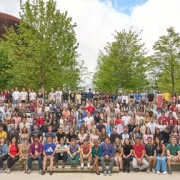
The Center for Computational & Data Sciences (CCDS) is organizing a 5-day summer school on “Random Matrix Theory” from 30th June to 4th July 2024.

Lecturer

Arijit Chakrabarty, PhD
Associate Professor
Theoretical Statistics and Mathematics Unit
Indian Statistical Institute
Kolkata, India
Website: Arijit Chakrabarty (isical.ac.in)

Place

Room#6002, BC, Independent University, Bangladesh

Schedule

  • Lecture: 09:30 AM  – 11:00 AM
  • Coffee Break :  11:00 AM – 11:30 AM
  • Lecture:  11:30 AM – 01:00 PM
  • Lunch: 01:00 PM – 02:30 PM

Lecture Plan

  • Lecture 1: Basics of random matrices – Wigner and Wishart matrices, empirical spectral distribution, the method of moments, Stieltjes transform.
  • Lecture 2: Convergence to the Wigner semicircle law – a complete proof via the method of moments.
  • Lecture 3: Study of Wishart matrices, the convergence of the empirical spectral distribution to the Marchenko-Pastur law – a complete proof via Stieltjes transform.
  • Lecture 4: The largest eigenvalue and eigenvector of perturbed random matrices with independent entries. Emphasis will be on finite rank perturbations.
  • Lecture 5: Connections between random matrices and random graphs – study of the bulk and edge of the spectrum of the adjacency matrix.

Resources

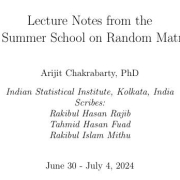
Lecture notes from the school are available here.

Participants

NameInstitute
Hasif AhmedLawrence University
Rakibul Hasan RajibCCDS, IUB
Md Tahmid Hasan FuadCCDS, IUB
Md Mubtasim AhasanBrac University
Walid HasanBrac University
Mohammad Tahmid SahriarBRAC University
KishorCCDS, IUB
Mir Sazzat HossainCCDS, IUB
Jahir Sadik MononCCDS, IUB
Aldrin Kabya BiswasCCDS, IUB
Syed Emad Uddin ShubhaBUET
Mohibul Hasan TarekNSU
Rashedul Islam SeumUniversity of Dhaka
MD AKIL RAIHAN IFTEECCDS, IUB
Rahul RohitCCDS, IUB
Nur Mohammad SalemUniversity of Dhaka
Md. Rakibul Islam MazumdarUniversity of Dhaka
Abdullah Ibne Hanif AreanUniversity of Dhaka

Undergraduate Project Update Presentation Day

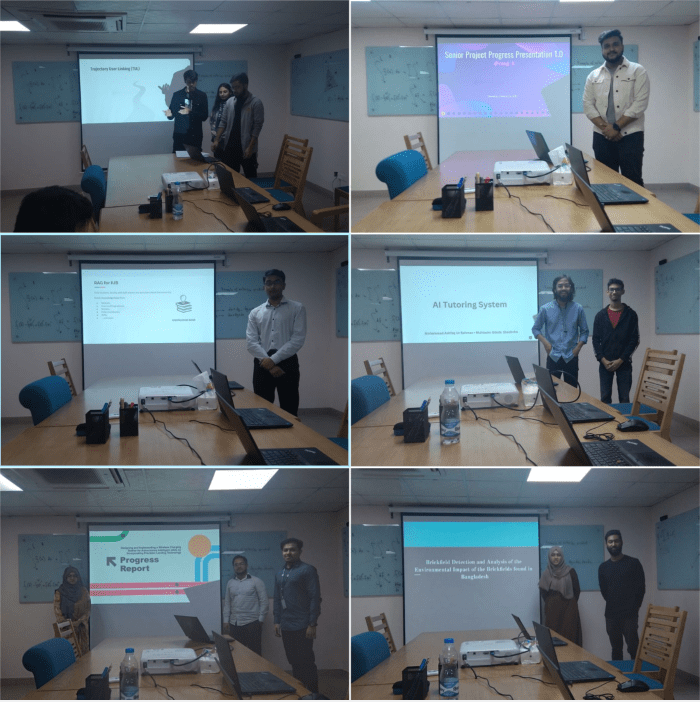
CCDS Undergrad Project Update Presentation Day, held on February 8, 2024. Eight groups, under the supervision of CCDS mentors, showcased their progress and findings. The presentations encompassed a diverse range of topics and research endeavors. It was a culmination of dedicated efforts and collaborative work within the CCDS community. The event provided a platform for students to share their achievements and insights with peers and faculty members alike.

Five Papers Accepted in EMBC 2024

We are happy to announce that five of our papers have been accepted in EMBC 2024. Papers are titled with:


  1. Mohammad Arshad Hossain Ratul, Tunisha Yanoor Bristy, Noorjahan Sayeed, and Ashraful Islam, “mHealth Tool for Gestational Diabetes Mellitus Management and Education in Bangladeshi Women”, EMBC 2024.

  2. Jahanggir Hossain Setu, Nabarun Halder, Ashraful Islam, “Streamlining Multi-Omics Analysis for Enhanced Predictive Model”, EMBC 2024.

  3. Nabarun Halder, Jahanggir Hossain Setu, Ashraful Islam, “Smartwatch-Based Human Stress Diagnosis Utilizing Physiological Signals and LSTM-Driven Machine Intelligence”.

  4. Md Asif Bin Khaled, Ashraful Islam, “Relational Agent-Enabled mHealth Platform for Addressing Dengue Crisis in Bangladesh”, EMBC 2024

  5. Md Junayed Hossain, Ashraful Islam, “Leukemia Classification: a Comprehensive Evaluation of Deep Learning Models with Pixel Reduction”, EMBC 2024.

DPS IUB Summer School 2024: Glimpses into the Quantum World- Information, Technology, and Applications

Introduction

The Department of Physical Sciences (DPS) of Independent University, Bangladesh (IUB) is going to organize a summer school. The title of the school is “DPS IUB Summer School 2024: Glimpses into the Quantum World- Information, Technology, and Applications“. The school has two parts: 1) pre-school, 2) main school. In the pre-school lectures will be delivered by the experts to make the students prepared for the main school. In the main school, guest lecturers will deliver lectures on some exciting developments in the area of quantum information theory and technology.

The following courses will be offered.

  • Necessary mathematics
  • Quantum mechanics essentials
  • A crash course on quantum computation
  • Geometric and holonomic quantum computation
  • Topological phases of matter
  • Open quantum systems

Eligibility

Completion of Linear Algebra, and Quantum Mechanics is recommended. However, in the pre-school the basics will be covered.

Registration

The date of the pre-school is May 4-9, 2024. The main school will be held from May 11-16, 2024. If you are interested to attend the school, please apply via filling this form.

The pre-school

The purpose of the pre-school is to make the students prepare for a smooth transition to the main school. With a view to achieving this goal, the following courses are offered.

  1. Necessary Mathematics by Dr. Jewel K. Ghosh
  2. Quantum Mechanics Essentials by Prof. M. Arshad Momen
  3. A crash course on quantum computation by Prof. Tibra Ali

Main School

In the main school, leading experts will deliver lectures on different topics. The tentative topics are the following.

  1. Geometric and holonomic quantum computation by Prof. L. C. Kwek
  2. Topological phases of matter by Prof. Subhro Bhattacharjee
  3. Open quantum systems (online) by Prof. Manas Kulkarni

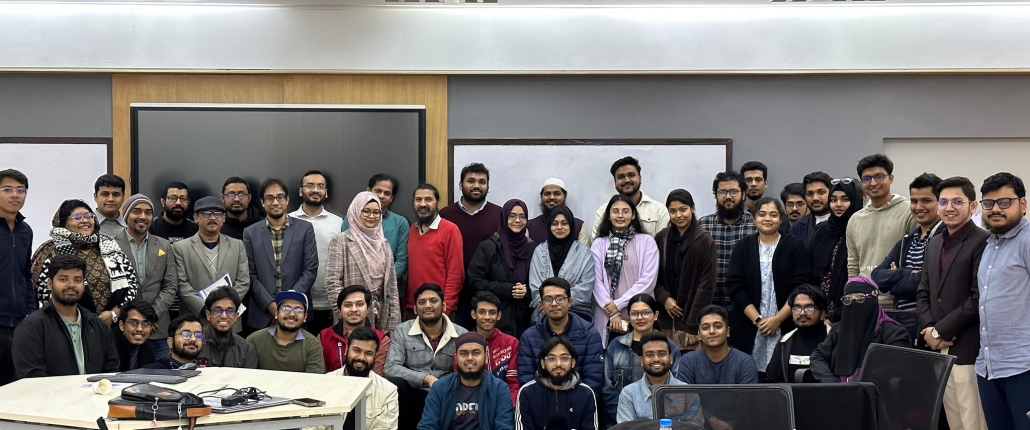
CCDS arranged a 3 day workshop on Systematic Literature Review

January 24, 2024

CCDS arranged a 3-day workshop titled “Insider’s Guide to Systemic Review & Research Paper Writing – A Hands-on workshop” at IUB. 58 participants completed the 15 hour workshop spread over 3 cold winter days, starting at 10:30am and ending at 4:30pm every day. Participants included students, research assistants and faculty members from IUB.

Dr. Ashraful Islam, Co-director of HCI wing of CCDS and Assistant Professor of dept of CSE, conducted the workshop. MS students of dept of CSE and research assistants Jahanggir Hossain Setu and Nabarul Halder from assisted him. CCDS director Prof Ashraful Amin handed over the certificates to the participants at the closing ceremony today.

CCDS plans to arrange similar workshops in near future which will be open to all.